Come Here, Boy
Only three weeks left on Olu’s student visa before he has to leave Germany. None of our German colleagues at the English Theatre Frankfurt are available, so my shoddy B2/C1 level is the best we can do to call the immigration office and hopefully figure out another way for him to stay in the country he’s lived, worked, invested in for the past 3 years.
We’ve been working together for two of those years. Olu’s a gem, creative, silly, warm, glad to work in an artistic environment, even for minimum wage as stagehand, hoping to be recognized in Germany as the writer and theater director he’s been for over a decade back in his country of origin, home no longer.
Carpenters are already working on the next set, both quiet and cell phone reception are nowhere to be found, so up and out we go, back into the same building, the Galileo skyscraper, home of Commerzbank. There’s a spacious café there, huge, immaculate, soulless, designed for bankers to welcome and impress clients. Olu goes through the revolving doors first; I follow directly in the next section. He waves hello to the security guard ten meters away before turning left to the café.
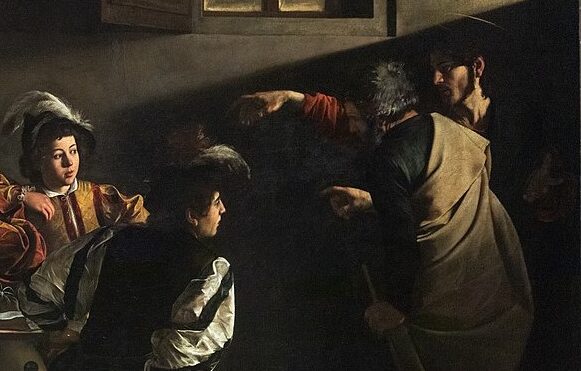
The guard beckons Olu over with a hooked, waving finger. Tense, authoritative. Like you would a misbehaving child in trouble, yet without any hint of warmth. Condescending at best. As my co-worker moves towards him, I follow. Already a subtle switch in his attitude as he notices we are together. He first addresses Olu in German, which he hardly speaks. Asks him what he is doing here. I come in; answer that we’re just going to the café. He turns to me, sweetens up, addresses me as ‘mein Lieber’ (my dear), tells me we have to go through him and that he can kick us out if he wants to.
At that point I am very much confused, never having had to justify my presence anywhere in Germany and having never experienced such unwarranted hostility. Olu is silent and inscrutable, his face expressionless.
He might not speak German, but he knows that language all too well.
I meekly tell the guard the café is a public space before he cuts me off and tells us to just go. As we walk away, Olu half-turns to me and sarcastically mimics that initial beckoning gesture. The guard catches it and yells at us to come over again. We hesitate before making our way back to the desk.
‘And?…’ a world of unspoken depth, aggressively reacting to the shame of his blatant racism being brought to the open. He knows we know what he is talking about. He wants to control the narrative of the conversation he knows we will have, the one we started non-verbally with that repeated gesture. Yet he can’t talk about it, can’t openly admit to anything. He starts asking my co-worker what that was about. Olu stays silent, between his wariness to acknowledge what was happening, wanting to avoid escalation, and his hesitant grasp of the language. I explain to the guard that he doesn’t speak much German. Following which, he turns to me and never again glances at Olu.
‘What was that?’ he scolds us. I don’t answer for a few seconds, following Olu’s response of conflict avoidance. This is not my story, this moment is not mine. If it escalates, I will back him up, and yet this passivity feels wrong, hinging on not openly acknowledging the weight of the moment, pretending it could be a non-racial misunderstanding.
I tell the guard we just want to go to the café. He gives up and motions us to go. Motions me, rather, my co-worker stopped existing in his mind, his presence ignored, erased. Conveniently swept away in his indignant rebuttal to our acknowledgment of his racism, his desperate attempt to control us further.
Once at the café Olu laughs it off.
‘Happens all the time. I never experienced that before coming to Germany three years ago though. And you know what? It has happened to me here already. I was meeting up with Tanja here to set up my contract, and the staff asked me what I was doing. What business I had here. I mean I get it. The red-light district is next door, you know. A lot of bad people. Some of them have dreadlocks, like me. So, I get it but come on. I don’t look like a junkie. You can tell…’
We talk about the racism he experiences. About Germany, about the immigration, the bureaucracy here. About the security guard having Turkish roots. Internalized racism, xenophobia. We veer back into his practical struggles to get a visa beyond the one he currently has, ticking away by the day.
I call the Immigration office for him, my German barely good enough to understand those specialized terms. Automated message with 8 options. I have to play it three times to make sure I heard right and picked the appropriate case. I press number 6, renewing visas, or pending visa extensions. Offered solution is to send an email to the address on the Frankfurt website. Olu got the phone number after an email exchange telling him to call rather, because emails can’t be processed fast enough.
Great. Love me, some Catch-22, but now’s not the time to aesthetically contemplate irony. This system is hurting my friend, and millions in similar situations.
I redirect him to the few people around us who actually speak German as I’d love to help but I’m French, and don’t know anything beyond the seamless application and stay from within the EU. Privilege checked, one of many.
He leaves to yet another administrative meeting in Griesheim, thanks me, still positive, jovial, the security guard incident just another one in a long line of differential treatment.
Racist, negative, unfair, alienating, far worse, not different. Fuck euphemisms for a minute.
Here I am now. Exorcising the moment by writing about it. Why should I ever decide to publish this? An effort to expunge the white guilt by sharing it with readers? Proactively dealing with the shame linked to my white savior complex, talking for you, Olu, when you ‘couldn’t’ because of the language barrier? Weakly diffusing the tension. I wish I could say it was my approximate German preventing me from finding choice words, from reacting better, from reacting ‘properly’, whatever that means.
It’d have been the same awkward song and dance in English or French, let’s not pretend.
This is not a call for action. Writing this won’t change my forgetting about racism in a couple days, maybe hours. Object permanence and all that.
By all means, let us do more, be politically engaged if we feel so inclined, if we can muster the energy, but I for sure won’t throw anyone the first stone.
I’m sorry today was special, disgusting to me, but just another Tuesday to you. I’m sorry there is a world of difference between my experience getting to come to Germany, study in Germany, work in Germany, and stay in Germany if I choose to, as a pasty EU citizen. I’m sorry you got told to come over to that desk like a dog. I’m sorry the situation would not have occurred had I led the way through that revolving door, making it obvious we were together.
I’m sorry you needed a white chaperone to be allowed in this white world without being demanded justification to exist in that white space.
I’m almost too ashamed to have you read this text. Too ashamed of you seeing this is how I experienced these couple hours; of the chance you might think I view our relationship through the prism of the ‘otherness’ this world is constantly hurling at you. Of the chance it might be the case, in some minor way…
I’m sorry I will be allowed, encouraged to forget once again.
I’m sorry you just don’t get the same luxury.
Thank you for sharing and acknowledging everyday racism in your work, as it is too often overlooked or remains unaddressed by white people. It’s “small” moments like this that actually speak volumes. At best, they can help instil and spread awareness – and be utilized to learn from.
Thank you for your comment! There’s so much to be done that small actions like potentially raising awareness seem insignificant, futile even. Yet they’re part of the fight. And these moments are so loaded, can be so complex and awkward, if anything, I hope to (very) modestly contribute to have them talked about. Otherwise awkwardness will prevent us from genuine conversations or progress, and that’d be a win for racism.