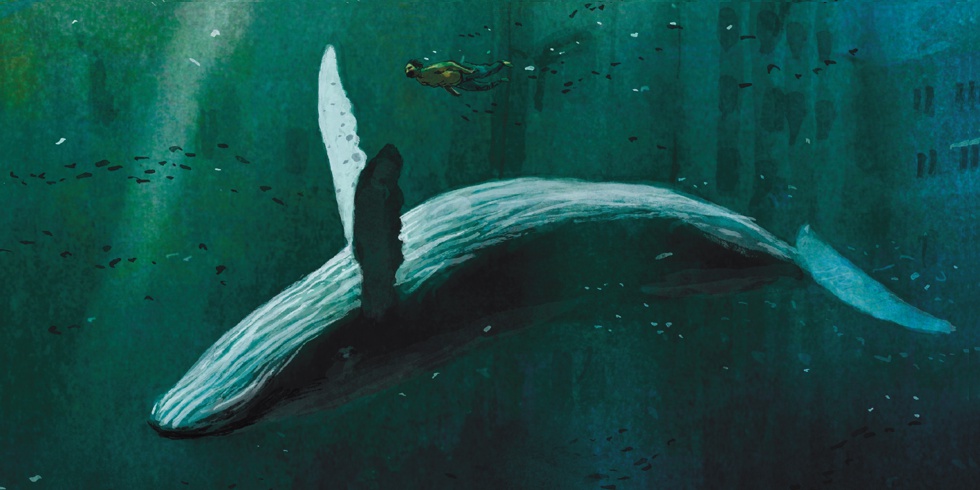
L’Age d’Eau: a Profound Lightness of Being
Joy and warmth suffuse my every pore during this rare sunny moment on a 26th of December, behind the glass window of my aunt and uncle’s chalet in the French Alps, as I linger on a couple awe-inspiring pages. Serenity. Here I can feel that things might just be all right, that they will be. Eventually.
L’Age d’Eau. Delicious French symmetry of that title. Age of Water.
Early Earth was Fire. Explosive magma, ebullient state of change. Water, earth and air eventually tamed that raging, roiling ball into the pale blue dot we know, love, revere, and foolheartedly mistreat even though our species and countless others depend on it for sheer survival.
Age of Earth, Ice age, denigrating water its center stage in our landlover’s egocentrism. It was always the Age of Water. Earth ought to have been named Oceanus, or maybe Aquaria, Thalassa, Mare, Azureus, Pelagos?
This bande dessinée (henceforth ‘BD’), written and illustrated by Benjamin Flao, stages a realistic, near future where water retakes its dominion, once more submerges larger swaths of dry earth we built our civilization upon. Water cares not for these structures, water simply is, wherever it is supposed to be.
Capitalism, in contrast, is dry, clean, static, neither organic nor flowing, it feeds on control, taming, exploiting, destroying flora and fauna, on and under the land, but also in the countless seas we have named out of the primordial oneness of Water. It is now its age once more. Capitalism has failed, perished. Long live Water and the creatures it spawns and nurtures. Extensions of itself. We are water more than we are earth and its fruits that sustain us. We do contain a fire fed by the air that sweeps through us, that animates our every motion, and yet, ultimately, essentially, we are water.
These words and ideas are not borrowed from the BD, they are what it gently tends to, encourages, nudges toward. Two volumes that could easily have been five, elegant concision against compulsive capitalist expanse. The plot is minimal: survival, adaptation, overcoming. Political tension, administrative exertion of violence in the first part slowly dissipate in the second, swept away by a current named life. Just the way it should be.
This BD is greatly enhanced by its first character, a transcendental being that quickly takes the shape and character of a ‘dog’. A blue dog. A blue dog with mind controlling abilities it sparsely uses. For good. To thwart bad. To put people where they ought to be. To turn them into who they could have been if not for the nefarious needs of capitalism and artificial material dearth.
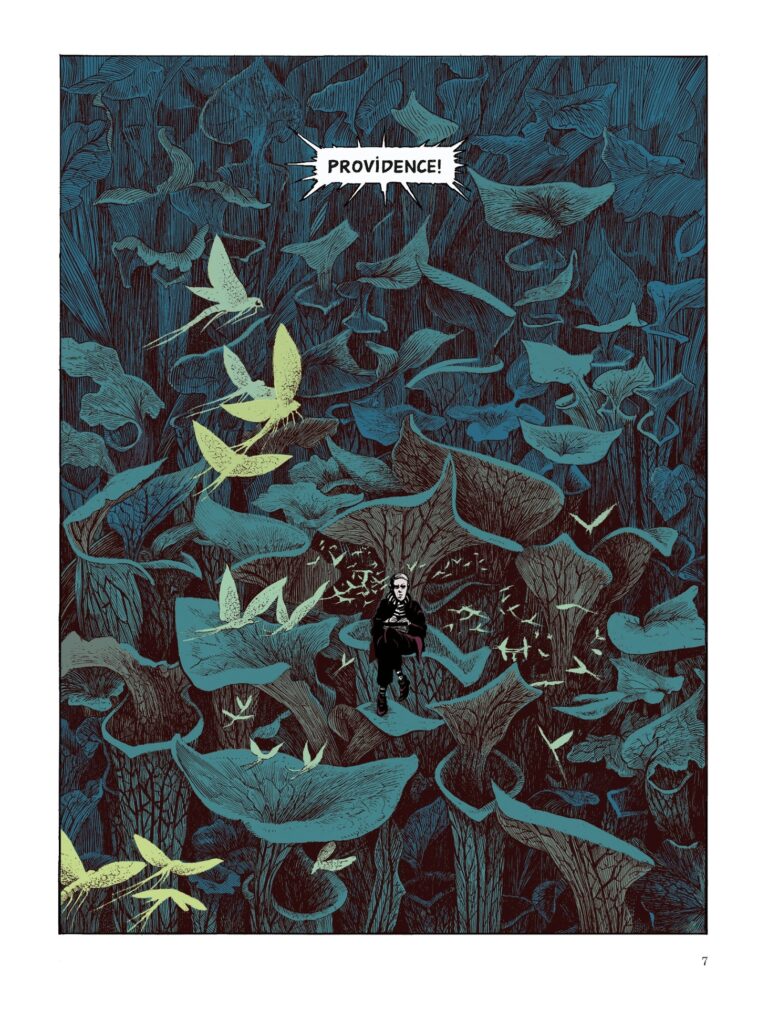
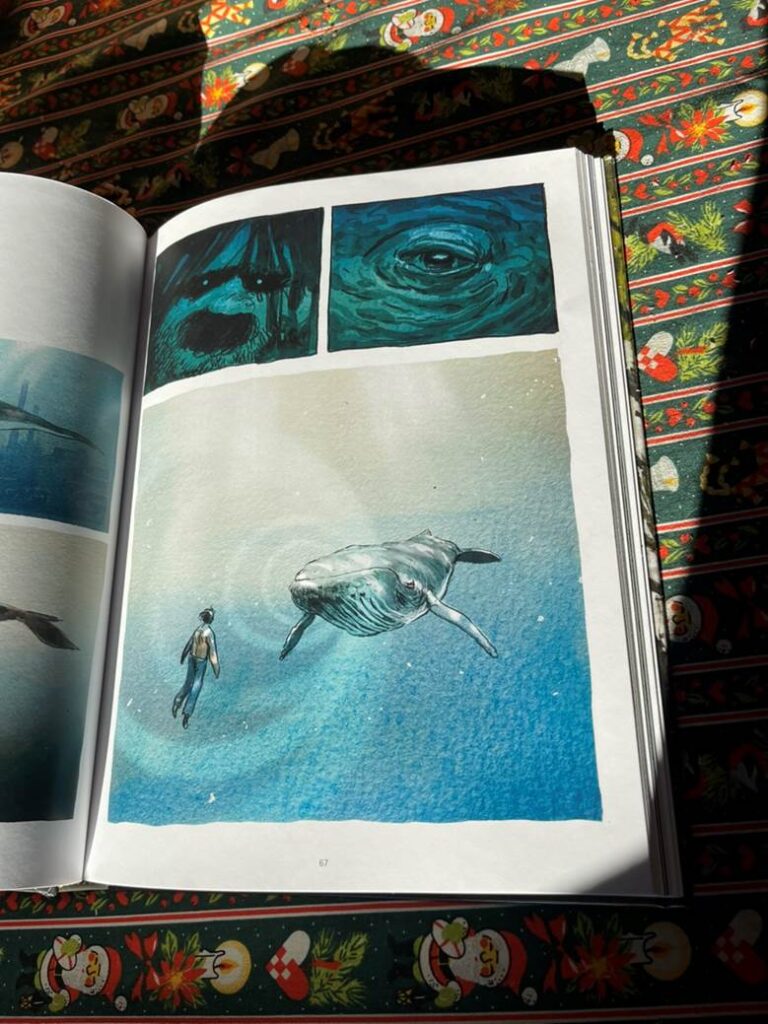
This dog sees, feels, thinks the world intensely. Waxes primordial poetics about its states in concisely pure, exact, organic French. These reflections accompany splendid, whole page illustrations taking life back to its essence, to a time beyond Time, before Man, the burdens of capitalism and neoliberalism unheard of, aeons away. Narrated through a dog’s sensibility, far from the simple beasts we reduce them to. Companions of humans, loving witnesses to our ancestors’ fortitude and our contemporary folly. Scale dissolving in Time, transcended, bringing a contextual flavor to plot advancements, which in turn sublimes it all, unmoors history from its fixed anchor, to the raging rapids of a reality we are scant equipped to perceive.
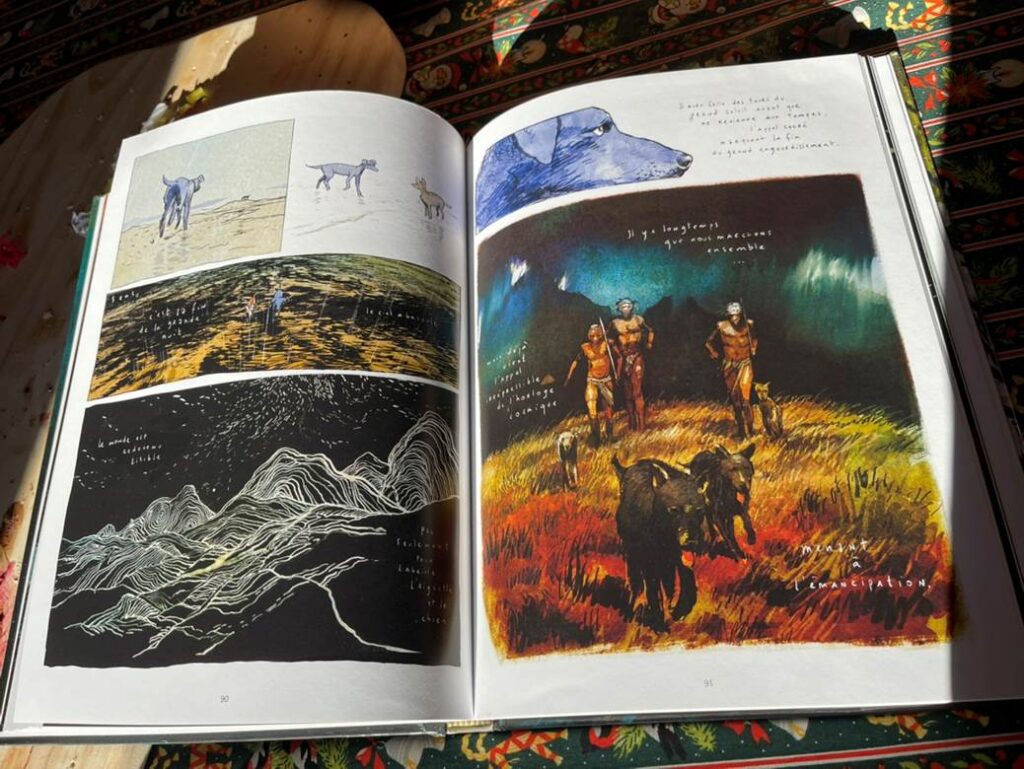
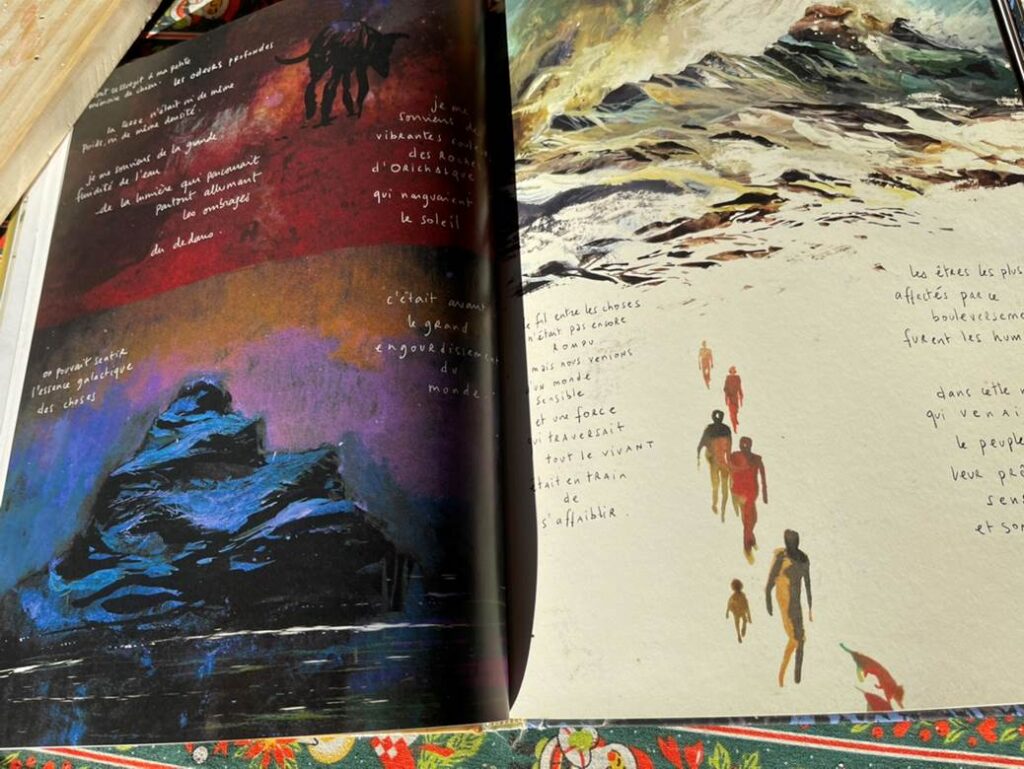
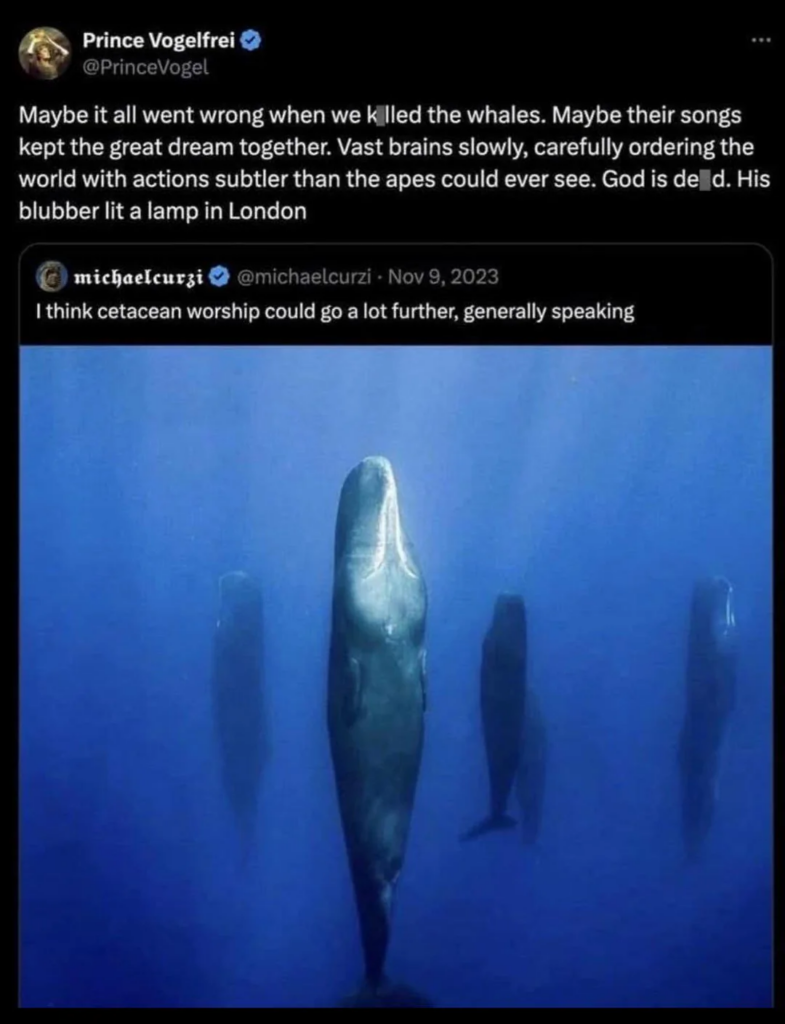
Once more I end up writing about water. My yearning to write about this BD became a necessity after catching myself being stuck contemplating the encounter between our blue dog (his color no coincidence) and a whale dormitory. Giants in their vertical slumber. Unfathomable Gods.
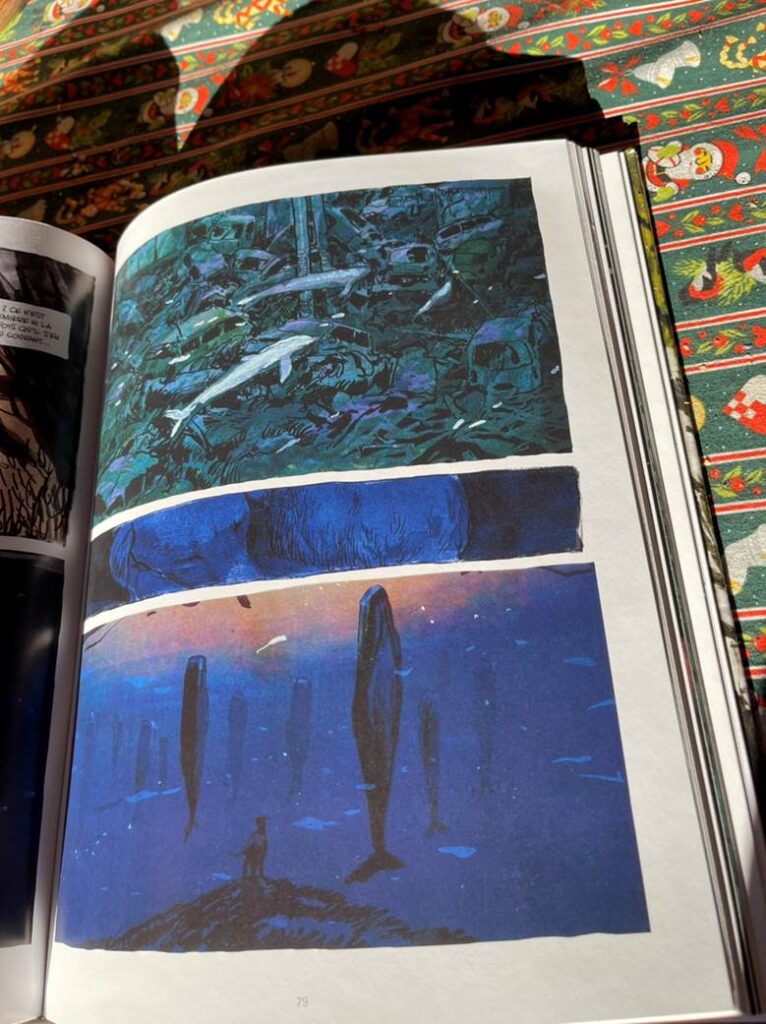
Bringing to mind a great multitude of sources that shaped my learning, reading about, veneration of whales, some of which I will have to write about in further articles. For now, their totality is deftly illustrated by one of my favourite twitter exchanges. Thank you, Vogelfrei, sweetest of princes, for gifting us those portentous, precise words and the infinite continuation of the ideas they brought to life.
“God is dead. His blubber lit a lamp in London.”
I wish I could one day write anything half as impactful and poetic as those five sentences.
Age of Water is both deeply human and anti-human (aka pro-Nature, or at least anti-State, anti-capitalism, whose confounding with Humanity insults our very core), this masterpiece is a love letter to existence, to life in all its forms, especially those we least understand.
Something about French, both rough in its concision and immensely expansive, evocative, malleable. “et je me chien” as the creature, first introduced to readers as anthropomorphic, tunes into ancient, primal feelings, and turns dog. “Je me chien”, “I dog myself” “me” is “me” or “myself”, homonymous to “meut”, “transforms”, the self a flux, liquid, uncontainable. “Je me chien” shouldn’t work, just as “I dog myself” sounds horrendous, terrifying. And yet here it is poetic, both light and transcending.
“I feel life everywhere like a shiver. Smells bump into another/each other and draw the precise frames of the world.” (“Je sens le vivant partout, comme un frisson. Les odeurs se bousculent, dessinent des contours précis au monde.”)
Boy, do I hate lyrical translation. How am I meant to convey, approximate such wealth, infinite weight of nuance and affect. It is both my loss and the English’s language. Don’t get me wrong, French couldn’t touch Shakespeare, Milton, or much of the lyricism specific to its berth, yet it’d be just as futile to pretend translating Proust or Verlaine into English without a dire loss of beauty, regardless of translators’ skills (and they abound, those people are mad, bold, and have my full, undying respect). My meager skills as interpreter will have to suffice for now, I’m afraid. The transition to dog is shown elegantly through language: “Mon esprit n’accable plus mon corps.”. My spirit/soul no longer burdens my body. Was the soul lost or its burden lightened? Both? Enough linguistics for now.
Characters are well-polished and deeply endearing. Gorza (silent, instinctual, animal), Jeanne (wise, skilled, facetious), Hans (hurt yet jovial, capable), Vinee (punk, strong, questing), and a slew of minor characters are fleshed out, real, are profoundly human. Humanity and its resilience are a large part of Age of Water. A Humanity free from its neoliberal chains, rejecting the accursed system’s death rattle of attempted control, with firm love and kindness.
Deeply optimistic work, without shying away from the rough side of humanity, desperate for survival. Those dark, dangerous encounters are diffused by the dog, Gorza’s instinctive empathy, Jeanne’s playful manipulation and drug-assisted nudging, Hans’ charm, or Vinee’s violence and strength of will.
Interspersed throughout the BD are nuggets of perspective and wisdom from dog, but also Gorza and Jeanne, bringing a more contemplative, peaceful pacing, a good mesh with the slow trek on water.
Gorza specifically, as the embodiment of Nature, the perfect animal, empathetic and instinctive. His brother Hans (probably not biological, but how important are blood ties in a world beyond property and material inheritance, really?) explains him and his muteness perfectly: “Gorza thirsts for skies, hungers for the infinite. Bothers no one with it. Breathing, drinking, eating, and taking care of others are enough for him. He has no need for sentences. Where others use words, he acts.”
And indeed, Gorza is nothing but action, in perfect communion, osmosis with the world, not one around him, but one he doesn’t distinguish from himself.
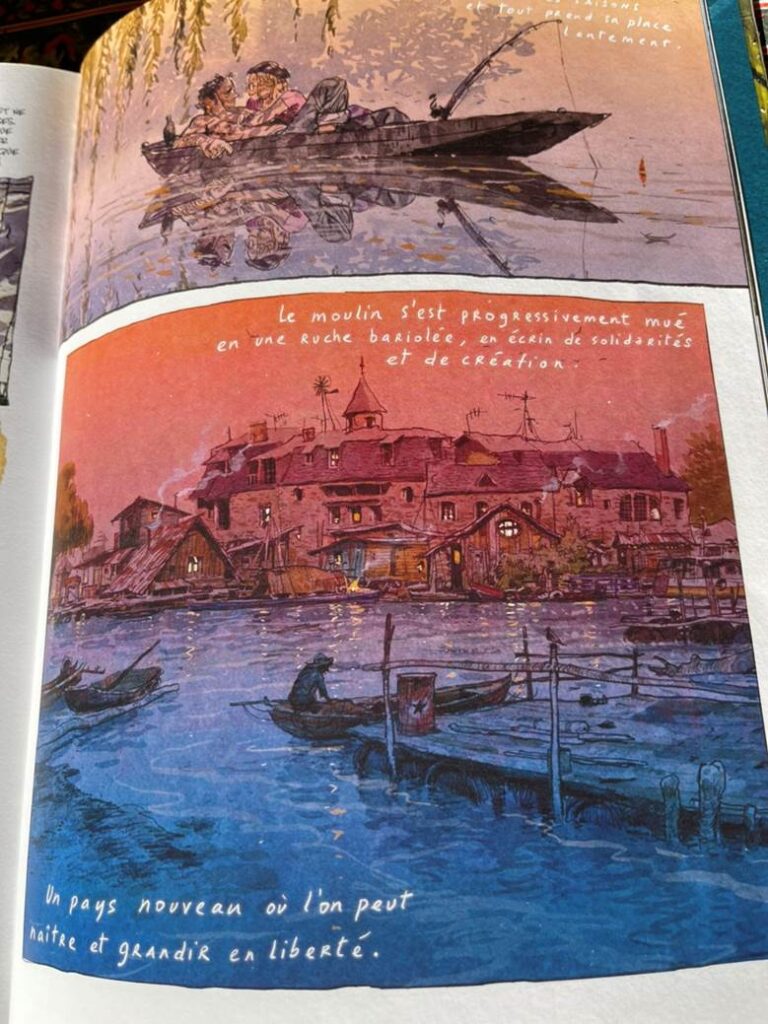
Pockets of resistance are richly depicted in all their makeshift glory with gardening galore, glorious gallivanting. Post-apocalyptic scenarios usually focus on the bleak, on hardships, yet here what appears is a realistic depiction of what will help dismantle capitalism: community, mutual assistance, sharing. In a world where Nature deatomizes our existence we finally start sharing, start living, building things and lives together. We are back to a love and communion with Nature after centuries of short-sighted, naïve domination.
Hope rings full, vibrant, and politics are necessarily local. Imperfect perfection, the second volume’s lightness prevents its own criticism for lack of depth. Not every problem is preemptively treated. Issues for these communities will arise, are already there. Yet the overarching hue is definitely blue, takes on the color of hope, and our characters will prevail. Age of Water ends right where it started, having accommodated for just enough political theory and scientific commentary. It is all there, but philosophy, life, keep center stage, just the way it should.
To fetishize one fixed, all-encompassing, all-fitting solution is the fruit of capitalist indoctrination. Solid certainty will not do, is the essence of Fascism. The solution, the future will be water and will forever remain in motion. Age d’Eau rides a current, one born many billion years ago, fed by the history of torrential rivers of resistance and revolution. It does not claim to be the current nor to contain it, it simply, organically flows wherever it ought to.
And so should we.